
If you’ve been watching gas prices at the pump lately, you’re probably confused. Oil analysts keep talking about global oversupply and falling demand, yet your fuel costs remain stubbornly high. Here’s what’s actually happening in 2026, and why the story matters differently for southern Alberta than the headlines suggest.
The global oil market is caught between two competing forces right now. On one side, OPEC+ production decisions and geopolitical tensions in key shipping routes keep prices volatile. On the other, predictions of supply surplus from increased production in North America and slower-than-expected global demand growth should theoretically push prices down. This tug-of-war creates the contradictory news you’re seeing.
But there’s a uniquely Canadian angle that doesn’t always make international headlines. Western Canadian Select, our benchmark crude, typically trades at a discount to the West Texas Intermediate price you hear about on the news. That discount widens or shrinks based on pipeline capacity, refinery maintenance schedules, and how easily we can get our product to market. Right now in mid-2026, transportation bottlenecks mean that even when global prices dip, the savings don’t always reach your tank as quickly as they should.
For those of us in southern Alberta, understanding this split matters. We live in oil country, so these price swings affect not just what we pay for gas, but local employment, provincial revenue, and the overall economic health of our communities. Let’s break down what’s really driving prices this year.
The Big Picture: What’s Actually Happening with Oil Prices
If you’ve been watching the headlines lately, you’ve probably noticed oil prices seem to be doing two opposite things at once. Some stories talk about a coming supply glut that should push prices down, while others focus on spikes driven by international conflicts. Both narratives are actually true, and understanding how they coexist is the key to making sense of what’s really happening.
The broader trend for 2026 points toward lower prices. A wave of new supply is expected to create a market surplus through the year, which typically eases upward pressure on prices. Analysts have been projecting this drift downward as production capacity ramps up globally. Think of it as the market’s baseline expectation, the steady current beneath the surface.
But oil markets don’t run on baseline trends alone. Geopolitical risks tied to Russia, Venezuela, and Iran continue to create sharp, short-term volatility. When conflict flares up or a major producer faces sanctions or supply disruptions, prices can spike quickly as traders react to potential shortages. The Iran war, for instance, has recently pushed prices higher on fears that supplies might tighten in the near term.
Here’s the thing: whether prices look like they’re skyrocketing or sliding depends entirely on which benchmark you’re watching and what timeframe you’re considering. West Texas Intermediate might surge on geopolitical news one week, while longer-term forecasts still point to softening prices months out. Canadian benchmarks like Western Canada Select move on their own dynamics too, adding another layer of complexity. For anyone trying to follow along in southern Alberta, that means the story shifts depending on where you look and when you look at it.

Understanding the WCS Discount: Why Canadian Oil Sells for Less
If you’ve been scratching your head about why Canadian oil prices seem disconnected from the headlines, the Western Canada Select discount is your answer. WCS is the benchmark price for heavy crude produced in Alberta and Saskatchewan, and it always trades below lighter North American and international benchmarks. Right now, that gap is sitting at $16.65 a barrel below West Texas Intermediate futures for May delivery in Hardisty, Alberta, and it just widened by $1.50 since last week.
To understand why this matters, here’s a quick breakdown of the benchmarks you’ll hear about:
- Western Canada Select (WCS)
- The benchmark price for heavy, high-sulphur crude oil produced primarily in Alberta and Saskatchewan. It’s the blend that matters most to our provincial economy.
- West Texas Intermediate (WTI)
- The main North American benchmark for light, sweet crude oil. WCS is priced relative to WTI futures, which trade much higher.
- Brent
- The global benchmark for lighter crude oil, originating from the North Sea. Like WTI, it commands a premium over heavier Canadian blends.
So why does WCS sell for less? The physics and chemistry matter here. Canadian crude is heavier and contains more sulphur than WTI or Brent, which means refineries need more complex (and expensive) equipment to process it. That inherent quality difference accounts for part of the discount, and it’s permanent. You can’t change the molecular structure of what comes out of the ground.
The recent widening of that discount tells a different story. The Iran conflict has spiked WTI prices on fears of near-term supply disruptions, but those worries don’t apply equally to heavy Canadian crude. Markets believe lighter oil will be tighter in the short run, so WTI has surged while WCS lags behind. Transportation bottlenecks and pipeline capacity constraints also play a role in keeping the differential wider than the quality difference alone would suggest.
For producers in southern Alberta, this discount is a daily reality that directly affects revenue, investment decisions, and job security across the energy sector.
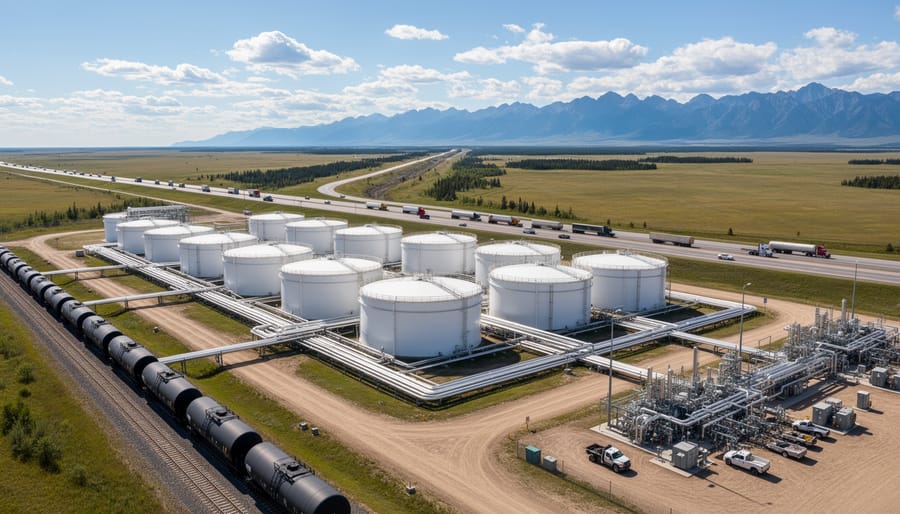
The Forces Driving Volatility Right Now
The oil market in 2026 is getting whipsawed by two opposing forces, and that’s exactly why prices swing so unpredictably from week to week.
On one side, you’ve got the Iran conflict acting like a spark in a dry forest. When tensions flared earlier this year, markets reacted immediately with supply fears that sent crude prices climbing. Traders know that any disruption to Middle Eastern oil flows, even briefly, can tighten global supply fast. That fear factor drove the recent surge in WTI prices, which in turn widened the discount on our Western Canada Select. Markets price in worst-case scenarios when geopolitical tensions heat up, regardless of what actual production numbers say.
But here’s the counterforce: a genuine wave of new supply is hitting the market. Analysts at Goldman Sachs project that oil prices will drift lower through 2026 as this supply creates a market surplus. New production from multiple sources around the world is coming online faster than demand is growing, which should theoretically push prices down over the medium term.
So which is it? Rising or falling? The frustrating answer is both, depending on your timeframe. Short-term geopolitical shocks create price spikes that can last days or weeks. The longer-term supply fundamentals point toward softer prices over months.
What keeps this volatility machine running are the wild cards that refuse to go away. Russia remains an unpredictable player in global energy markets, and Venezuela’s production situation continues to create uncertainty. Iran’s ongoing conflict adds another layer of instability that can flare up without warning. These geopolitical risks tied to Russia, Venezuela and Iran will continue driving volatility throughout the year.
For southern Albertans watching their retirement accounts or wondering about the next round of energy sector layoffs or hiring, this contradiction matters. The market isn’t broken, it’s just pricing in two different realities at once.
What This Means for Southern Alberta
So what does all this price turbulence mean for folks in southern Alberta? The short answer is uncertainty, and in the energy sector, uncertainty slows everything down.
When the WCS differential widens to more than $16 below WTI, it directly cuts into what producers here can earn on every barrel. That squeeze ripples through the entire regional economy. Energy companies become more cautious about drilling new wells or expanding projects, which means contractors, service firms, and equipment suppliers all feel the slowdown. If you work in the patch or supply it, you’ve probably already noticed clients pumping the brakes on spending decisions until they get better clarity on where prices are headed.
For the provincial government, volatile oil prices make budgeting a nightmare. Alberta’s revenues swing with every sustained price shift, affecting everything from infrastructure projects to public services. A wider discount means less money flowing into provincial coffers, even when global benchmarks look reasonably healthy.
The good news is that Calgary’s energy sector has weathered price swings before and learned to operate leaner. Many producers here can still turn a profit even with WCS trading at a discount, especially if they’ve locked in costs during better times. Investment decisions are on hold rather than cancelled outright, and most forecasts still expect supply growth through the year.
The reality for southern Alberta is a waiting game. Companies will keep existing operations running, but major new commitments will likely stay on the shelf until the geopolitical wildcards settle and the supply surplus picture becomes clearer. It’s not a crisis, but it’s not a growth moment either. Just the kind of in-between period that tests patience across the industry.

Looking Ahead: Supply Surplus vs. Geopolitical Wildcards
So where does this leave us for the rest of 2026? If you’re trying to make sense of what comes next, you’re in good company, even the analysts can’t quite agree.
On one hand, the fundamentals point to a softer market. A wave of new supply is expected to push global production higher than demand, creating the kind of surplus that typically drags prices lower. Major forecasters see this playing out through the year, with oil drifting down as more barrels hit the market and supply outpaces consumption growth.
Oil prices are likely to drift lower in 2026 as a wave of supply creates a market surplus, according to Goldman’s latest projections.
But here’s the catch: geopolitical risks tied to Russia, Venezuela and Iran aren’t going anywhere. These are the wildcards that can send prices jumping on a moment’s notice, as we saw with the recent Iran conflict that widened the WCS discount and drove short-term volatility. A single supply disruption, sanctions announcement, or military escalation can override the surplus narrative and spike prices temporarily.
Both stories can be true at the same time. The long view favors lower prices as supply builds, but the short term remains vulnerable to shocks. If you’re watching WTI futures day-to-day, you’ll see those geopolitical jitters reflected in the swings. If you’re planning budget forecasts or investment decisions over months, the supply surplus matters more. It’s less about which forecast is right and more about which timeframe you’re focused on, and understanding that the market is juggling both realities simultaneously.
So where does that leave us? Oil prices in Canada aren’t simply going up or down, they’re caught in a tug-of-war between the WCS discount that keeps our crude selling at a disadvantage, short-term geopolitical shocks that rattle markets, and a broader supply wave that analysts expect will soften prices over the coming months. These forces don’t move in lockstep, which is exactly why the headlines feel so contradictory.
We want to hear from you. How are these swings affecting your work, your business, or your community? Call in and share your perspective with our hosts, whether you’re in the oil patch watching rig counts, running a service company dealing with uncertainty, or just trying to make sense of the news. Your voice matters, and these conversations help all of us understand what’s really happening on the ground in southern Alberta.